EduApp: quality education accessible to every Nigerian student
An adaptive e-learning platform for secondary school students in Nigeria, built for low-bandwidth environments, offline-first mobile use, and the realities of the Nigerian education system. It is live and helping students prepare for WAEC, NECO, and JAMB.
Visit the live site at eduapp.futsolins.com ↗
Figures reported by the live product at eduapp.futsolins.com, not a controlled study I ran. I treat them as evidence the approach is working at scale, not as proof my design alone caused them.
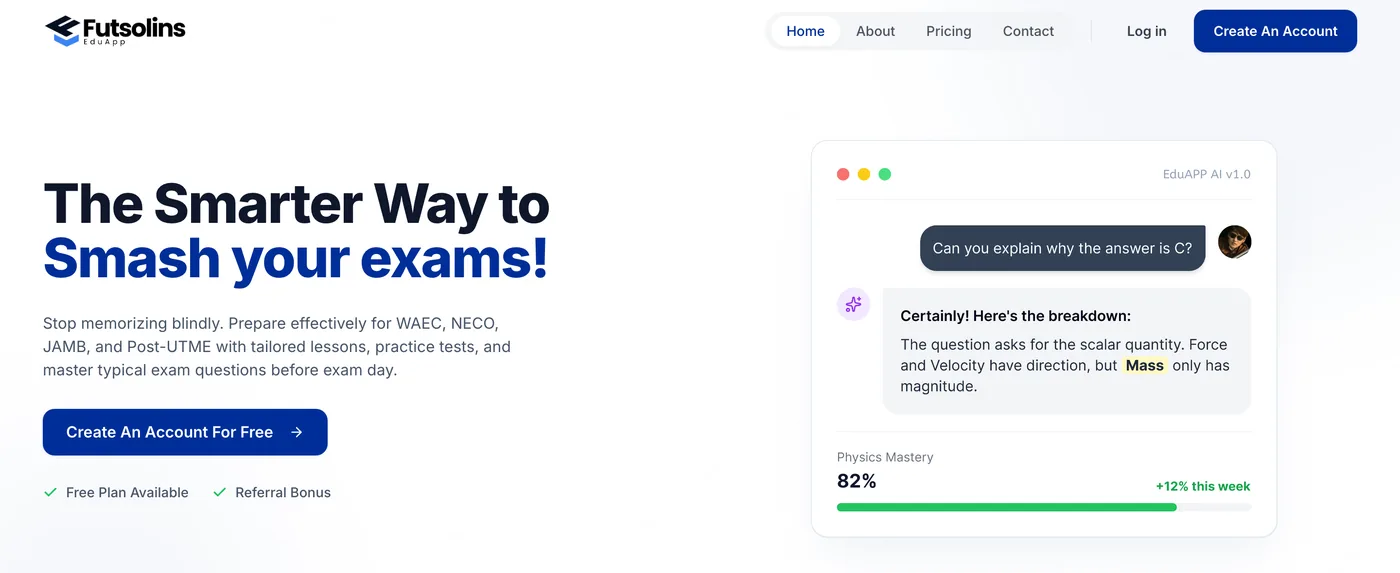
The live product at eduapp.futsolins.com: an AI tutor that explains answers and tracks mastery.
The constraint was the phone and the network
Nigerian secondary students preparing for WAEC, NECO, and JAMB do not lack motivation or content. They lack edtech built for the devices and networks they actually have: entry-level Android phones with 1 to 3GB of RAM, shared data plans, and 2G/3G coverage that drops on the bus and at home. Most existing tools assume Western infrastructure, so they are too heavy to install, too data-hungry to open, and useless the moment the signal goes.
My point of view going in was that the hardest design constraints were not pedagogical but physical. If an app could not load in seconds on a cheap phone, stay under a few megabytes, and work fully offline, none of the adaptive-learning cleverness would ever reach the student. So the brief I set was narrow on purpose: make curriculum-aligned, adaptive exam prep that is fast and useful with no connection at all.
Field research in Lagos
I interviewed 10 secondary school students, 4 teachers, and 2 school administrators across Lagos. Observed classroom dynamics, tested device capabilities, and mapped the actual learning journey.
Student interviews (n=10)
Students wanted bite-sized content for commutes, interactive quizzes that feel like games, and offline access. The #1 request: "Let me study without data."
Teacher interviews (n=4)
Teachers wanted curriculum alignment (WAEC/NECO syllabus), student progress tracking, and a supplement to classroom teaching.
Device audit (n=8)
Mix of Android 8-12, screens 5-6.5 inches, 1-3GB RAM. App must be under 15MB and load in under 2 seconds on 3G.
Competitive analysis
Analyzed uLesson, Tuteria, PrepClass, Khan Academy. Gap: none offered true offline-first with curriculum-aligned adaptive learning.
Three people the research kept surfacing
These are not invented profiles. Each one is a pattern that came up repeatedly across the student, teacher, and administrator interviews, named so the team could design against a real constraint rather than an average user.
The data-rationing commuter
"I study on the bus to school. I need something that works without data."
- Pattern
- Owns the phone but rations a shared data plan, so download-once-study-offline is the only model that fits her day.
- Design implication
- Offline-first is the product, not a feature. WiFi-time download, zero-data study.
The borrowed-device self-pacer
"Maths is hard and my teacher moves too fast."
- Pattern
- Studies in short evening windows on a phone borrowed from a parent or sibling, falling behind in class on the topics that compound.
- Design implication
- Adaptive paths that surface prerequisites; progress that survives logging in on a shared device.
The over-stretched teacher
"I have 60 students. I need to know who is falling behind."
- Pattern
- Wants a supplement to classroom teaching, not a replacement, and needs to spot the students slipping without grading every quiz by hand.
- Design implication
- Curriculum alignment to the WAEC/NECO syllabus and lightweight class-level progress visibility.
Built for the real Nigeria
Offline-first
Lessons download over WiFi. Students study completely offline. Progress syncs when connectivity returns.
Curriculum-aligned
Every lesson maps to WAEC/NECO syllabus. Search by subject, topic, and exam year.
Adaptive paths
Quiz results adjust difficulty and recommend review topics. Struggling with quadratics? The app surfaces prerequisite algebra first.
Ultra-light UI
App under 15MB. Every screen loads in under 2 seconds on 3G. Text-first, video optional for WiFi.
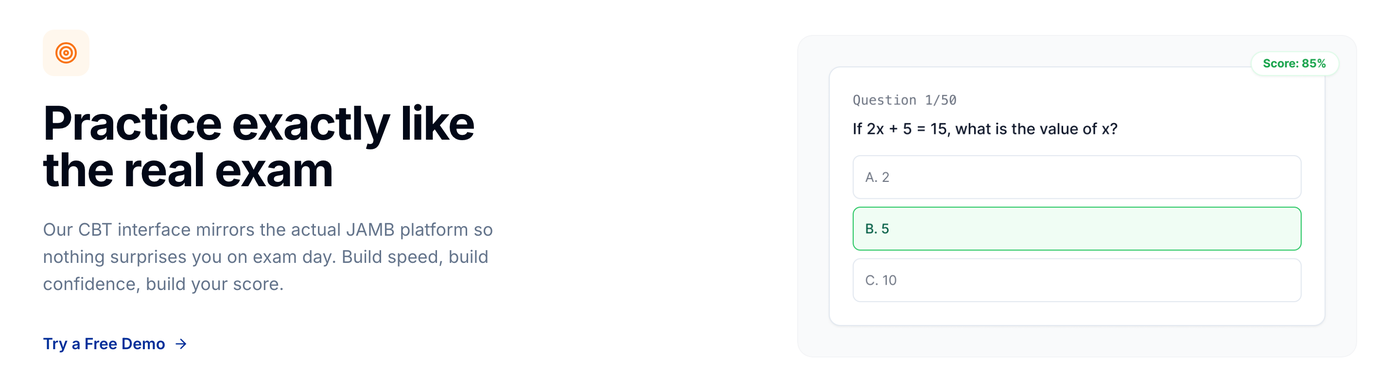
A CBT practice mode that mirrors the real JAMB exam, so speed and confidence build before exam day.
Tested with students and teachers in Lagos
Task completion
Key metrics
Offline mode was the most valued feature
7/8 students said offline access was the reason they would use EduApp over competitors.
Quiz timer caused anxiety
Changed to optional timer with untimed "practice mode" as default. Timed mode for exam prep only.
Students preparing better, at scale
In production the design decisions held up where it counts: on real phones, on real networks, during real exam seasons. The offline-first, curriculum-aligned, adaptive approach turned into measurable preparation.
15k+ active students, 2M+ questions solved
The light, offline-first build let students practice on the bus and at home, not just on WiFi, which is exactly what the research asked for.
92% pass rate, +12% weekly mastery
Adaptive paths and CBT practice that mirrors the real exam moved students from rote memorisation to measured, improving preparation.
Designing for a 2G connection
Great UX is not beautiful pixels on 4K screens. It is an interface that loads in 2 seconds on a phone with 1GB RAM and intermittent 3G.
Local context changes everything
Studying on a Lagos bus is fundamentally different from studying at a desk. Larger touch targets, sunlight-readable text, auto-save every 30 seconds.